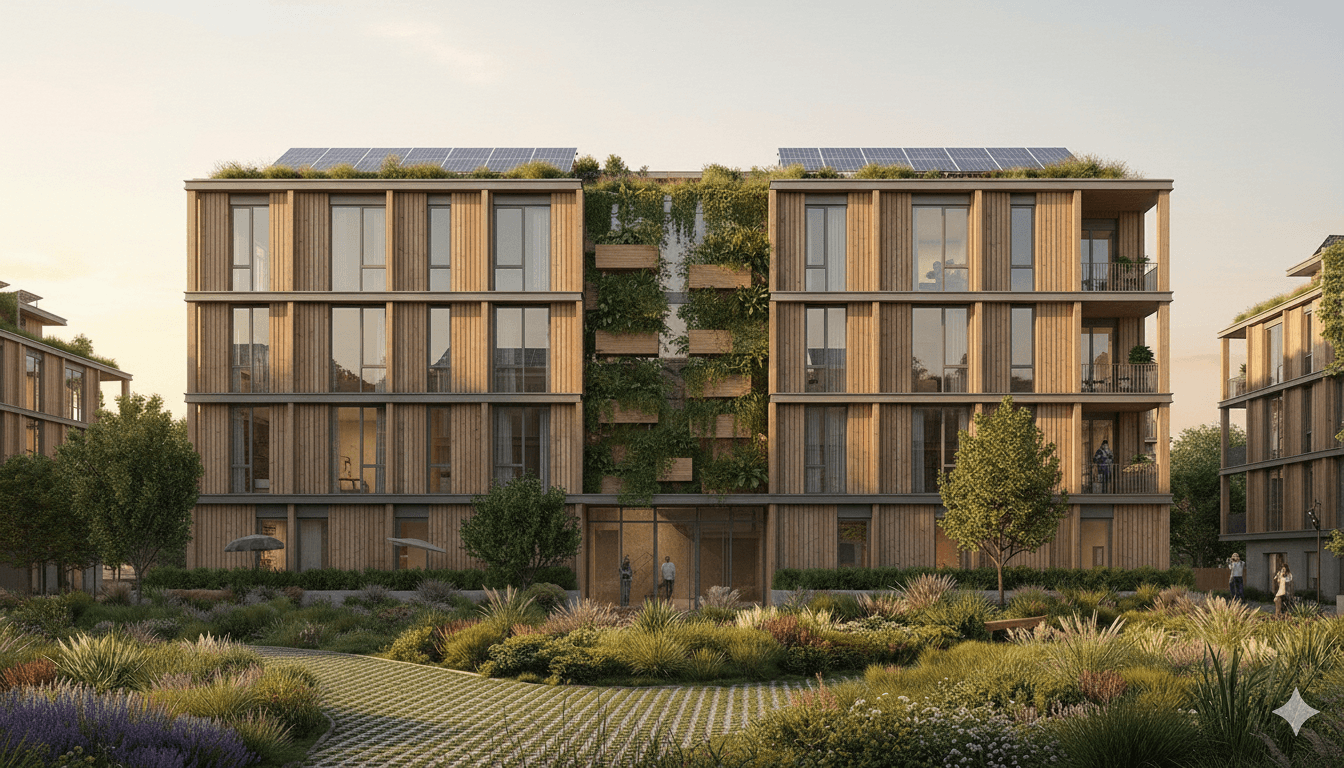
Modular construction is no longer a curiosity in Quebec — it is a serious answer to three very real problems: a short building season, a persistent labour shortage, and costs that keep climbing. Whether you are building your first home on rural land, replacing a cottage, or putting up a revenue-generating multiplex, understanding how modular actually works — and how it differs from prefab and mobile homes — changes the math. This guide covers everything from the factory process to financing to resale value.
As a residential and commercial real estate broker (OACIQ H2731) who has worked with Quebec modular builders, I have seen both sides: the justified enthusiasm and the costly pitfalls. Here is the honest version.
What "modular" actually means
The vocabulary creates a lot of confusion, and that confusion costs money — especially at financing and resale. Let us clearly separate the three main families of off-site construction.
Modular, panelized, and mobile
True modular (volumetric)
The home is built as complete three-dimensional volumes — "modules" with floors, walls, and ceilings — in a factory, then trucked and craned onto a permanent foundation. Crucially, a module must meet the same Quebec Construction Code as any site-built house. Once set and finished, it is legally and financially an ordinary house.
Panelized / pre-cut
The factory produces flat panels (walls, roof trusses) that are assembled on site. Less factory work than modular, but more design flexibility and lower transport cost. It is often the choice for hard-to-access sites.
Mobile / manufactured
Built on a steel chassis to a different standard (CSA Z240), it is not permanently affixed. This is where most of the financing and resale problems live — a mobile home does not appraise like a modular home. Never conflate the two.
A note on terminology
"Factory-built" is used loosely in Quebec for both modular and mobile. Always ask the one question that matters: permanent foundation and full Building Code compliance? If yes, it is modular in the sense your lender cares about.
Regulatory source
The Régie du bâtiment du Québec (RBQ) governs construction standards and contractor licensing, modular included.
Why Quebec is a natural market for modular
The build-season problem
Quebec's climate compresses traditional construction into a narrow window. Pouring foundations and framing in January is expensive and risky. Factory fabrication continues year-round in a controlled environment, and the module is then set in a day or two — often in deep winter. For land in the Gaspé, the Côte-Nord, or the Laurentians, that advantage is enormous.
Labour and cost
The skilled-labour shortage affects the entire Canadian construction sector, as the Canadian Home Builders\' Association (CHBA) documents regularly. The factory concentrates labour, cuts travel, and limits material waste — gains that matter doubly in remote regions where finding trades is hard.
The build process, step by step
1. Design and permits
You finalize plans with the builder and file for the municipal permit. Zoning, setbacks, and local requirements apply exactly as they would for any construction. This is often the longest step — start early.
2. Factory fabrication
Over 4–10 weeks, modules are assembled in the factory — framing, plumbing, electrical, insulation, windows, sometimes down to cabinets and flooring. This runs in parallel with site preparation.
3. Site prep and foundation
Excavation, permanent foundation (slab, crawl space, or full basement), services. The permanent foundation is what makes modular full real property.
4. Delivery and assembly
Modules arrive by truck and are craned into place — often in a single day. It is the dramatic step, but it requires clear access and planned transport logistics.
5. Finishing and hookups
Stitching the modules together, connecting plumbing and electrical to services, finishing the roofline, final inspections. Budget a few weeks before move-in.
What it costs in 2026
Finished cost per square foot generally sits between $180 and $320 for the building, but it is what is not in the builder's brochure that surprises buyers.
The hidden costs
Land and foundation
The factory price almost never includes land or foundation. See our land for sale page for the acquisition side.
Transport and crane
The more remote or hard-to-access the site, the higher this line. Get a firm transport quote before signing.
Services and permits
Well, septic, electrical connection, municipal permits, parkland fees. On unserviced land, these can rival the cost of a modest addition.
Financing a modular home
The construction draw mortgage
Most modular projects are financed with a construction draw mortgage, released as stages complete. A modular quirk: the builder often requires a large deposit before the factory delivers, which can create a gap with the lender's draw schedule. Raise this with your mortgage broker at the outset.
CMHC and modular
A compliant modular home on a permanent foundation is eligible for CMHC mortgage insurance on the same footing as a traditional house. For modular multi-unit projects, MLI Select applies to the finished asset — see our MLI Select financing guide.
Modular for investors: the multiplex angle
This is the most underrated application. Building a 4- to 8-unit modular building on well-zoned land can be competitive with buying existing stock — especially when the shortened timeline cuts carrying costs and gets units renting months sooner. Combined with CMHC financing, it becomes a genuine value-creation strategy. See our multifamily investment and new construction pages.
Before building, understand zoning and development charges — that is the subject of our zoning primer.
Regulation, warranty, and quality
The RBQ and the building code
Your contractor must hold an RBQ licence, and the home must meet the Quebec Construction Code. Always verify the licence before paying a deposit.
The residential construction warranty
Eligible new homes are covered by the Garantie de construction résidentielle (GCR) plan, which protects deposits, completion, and defects. The APCHQ is also a useful resource on best practices.
Modular homes and resale value
The most common fear — "it won\'t resell" — is largely unfounded for true modular. A compliant modular home on a permanent foundation appraises, finances, and resells like any house. Housing market data, tracked by bodies like Statistics Canada, does not penalize factory origin; what matters is location, condition, and compliance. When it is time to sell, it is exactly the same valuation work as any property — see our approach to selling a property.
Frequently asked questions
How much does a modular home cost in Quebec in 2026?
A finished modular home in Quebec typically runs $180–$320 per square foot in 2026 for the building itself, before land. A turnkey 1,500 sq ft modular house therefore lands roughly between $270,000 and $480,000 plus the cost of land, foundation, services, transport, and permits. The factory portion is usually 10–20% cheaper than equivalent site-built construction; the savings come mostly from speed and reduced weather risk rather than dramatically lower material costs.
Are modular homes a good investment in Quebec?
They can be, especially for multiplex and revenue-property projects. Modular construction shortens the build timeline by months, which reduces carrying costs and gets units renting sooner. For investors building on land they already own, a modular 4- to 8-unit building can be competitive with buying existing stock — and pairs well with CMHC MLI Select financing for the finished asset.
Do modular homes hold their value like traditional houses?
Yes. A code-compliant modular home on a permanent foundation is appraised, financed, and resold the same way as a site-built home — it is real property, not a mobile home. Quebec buyers and lenders treat a properly permitted modular house identically once it is set and finished. The key distinction for resale is permanent foundation plus RBQ-compliant construction, not the factory origin.
What is the difference between modular, prefab, and mobile homes?
"Prefab" is the umbrella term for anything built off-site. "Modular" means the home is built as complete three-dimensional volumes (modules) that are craned onto a permanent foundation and finished on site — it must meet the same building code as any site-built house. "Mobile" or "manufactured" homes are built on a steel chassis to a different standard and are not permanently affixed. For financing and resale in Quebec, modular behaves like a normal house; mobile does not.
How long does it take to build a modular home?
From signed plans to move-in, expect roughly 3–6 months versus 8–14 months for comparable site-built construction. Factory fabrication (4–10 weeks) runs in parallel with site preparation and foundation work, which is where modular recovers most of the time. Permitting and utility connections, not the build itself, are usually the longest variable.
Explore further
- → Multifamily & revenue property investment
- → New construction in Montreal
- → Land for sale
- → Pre-construction projects
- → Zoning & development charges primer
- → AI visual staging (aimmo)
About the author
Jeremy Soares is an OACIQ-licensed residential and commercial real estate broker (H2731) in Montreal. Trained in architecture, he has worked on modular construction projects and combines brokerage with AI-powered analysis tools.
Full profile